
Paint-Techs LLC — Jacksonville's Trusted Painters
Licensed & insured painting contractor with 52 five-star Google reviews. Serving Jacksonville, Nocatee, Ponte Vedra Beach, and Northeast Florida since 2020.
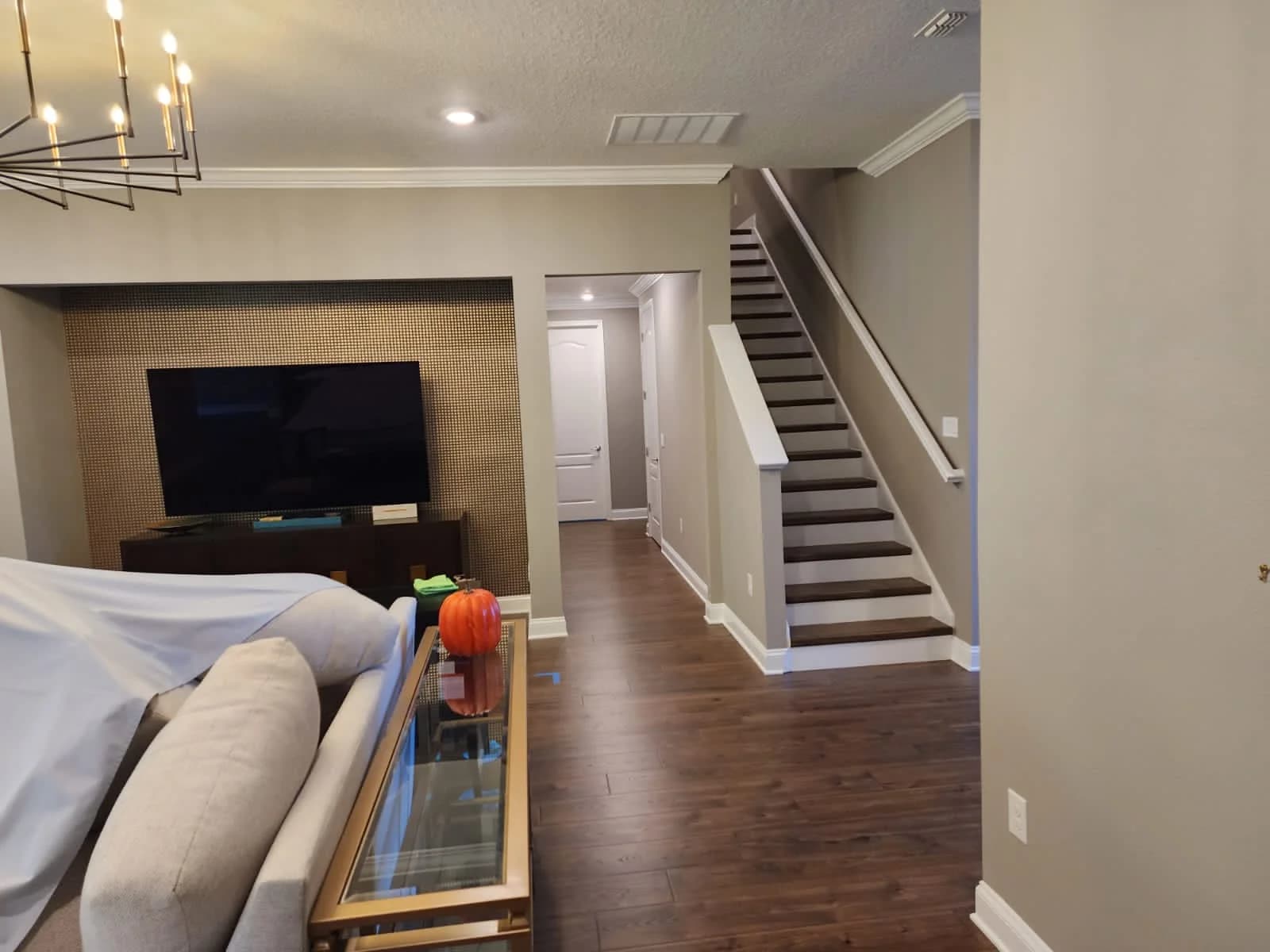
How do you decide which wall should be an accent wall?
The right accent wall is the wall you cannot avoid looking at. In any given room, there is one wall that draws the eye the moment you walk in. That is the accent wall. To find it, walk into the room from its main entrance and notice where your gaze lands. Nine times out of ten that wall meets one of these criteria:
If two walls compete (a sofa wall and a fireplace wall in the same room, for example), pick the one with no windows or doors. Accent walls work best on uninterrupted planes where the color can land in a clean rectangle.
Avoid making the entry wall (the wall you walk past, not toward) an accent. That wall does not get looked at and the color is wasted.
What is the rule for accent walls?
The rule for accent walls in 2026 is simple: one accent wall per room, on a wall with no windows or doors, painted in a color that is darker or richer than the other three walls, and pulled from a color already present in the room.
Five sub-rules that turn an accent wall from amateurish into intentional:
1. One per room. Two accent walls is no longer "accent". It is a two-tone scheme, which is a different design choice with different rules.
2. Solid, uninterrupted wall. Windows, doorways, and large built-ins break the visual rectangle and make the accent feel scattered. Pick a wall the eye can take in as a single shape.
3. Darker or richer, never lighter. A lighter accent wall makes the room feel unbalanced, like the wall is missing something. Go 2 to 3 shades deeper, or one full color step (light blue to deep navy, soft beige to terracotta).
4. Pull the accent color from the room. Look at your largest rug, your artwork, the dominant cushion color, your countertop veining. The accent wall color should already exist somewhere in the room so it reads as connected, not added on.
5. Coordinate trim and ceiling. Keep the trim and ceiling colors consistent with the other three walls. Painting trim in the accent color throws the whole composition off.
Are accent walls out of style for 2026?
No. Accent walls are very much in style for 2026, but the execution has changed. Today's accent walls lean toward sophisticated mid-tone and deep colors (navy, forest green, terracotta, charcoal, plum) rather than the bold red and lime green accent walls of 2010. They also lean toward textured techniques (board-and-batten, vertical shiplap, limewash) rather than just a single flat color.
What is *out* in 2026:
What is *in*:
Does an accent wall make a room look bigger or smaller?
An accent wall can make a room look bigger *or* smaller depending on where you place it and which color you pick.
To make a room look bigger: put the accent on the *farthest* wall from the entry, in a color slightly darker than the other walls. The deeper color pulls the eye to the back of the room, giving the room more visual depth. This works especially well in narrow rooms. Accenting the short wall at the end of a long room shortens it visually and makes it feel more proportioned.
To make a room look smaller and cozier: put the accent on a side wall (perpendicular to the entry), or use a very dark accent (charcoal, near-black, deep navy). These pull the walls in visually and make the room feel intimate. The right move in a large, echoey living room you want to feel more like a den.
To avoid shrinking a small room accidentally: never put a dark accent on the wall closest to the entry. That wall jumps forward visually and crowds the room.
How to choose an accent wall color
Pick an accent wall color in three steps:
1. Pull from something already in the room. Look at the largest rug, the artwork, the throw pillows, the upholstery. Pick a color that already exists in one of those. That is your accent palette.
2. Match the undertone of the other three walls. If your other walls are warm white, pick a warm-undertone accent (terracotta, warm navy, sage). If your other walls are cool gray, pick a cool-undertone accent (true navy, forest green, deep teal). Mismatched undertones make the accent fight the room.
3. Test 2-foot samples on the wall. Same rule as any paint color decision. Chip-sized swatches lie at scale. Paint a 2×2-foot patch, watch it morning, noon, and night for 24–48 hours, and commit only if it still looks right.
For a deeper guide on choosing the underlying paint color first, see our how to choose a paint color guide. For trending whole-house palettes, see our best white cabinet paint colors post: many of those whites pair beautifully with deep accent walls.
Need Help With Your Painting Project?
Paint-Techs LLC offers free estimates for all painting services in Jacksonville and Northeast Florida.
How to choose an accent wall in the living room
In a living room, the accent wall is almost always the wall behind the sofa or the wall framing the fireplace. The sofa wall works in 70% of rooms because the sofa naturally anchors the eye to that plane. The fireplace wall wins when the fireplace is large enough to compete with the sofa for attention.
Top 5 living room accent wall colors for 2026:
Pair any of these with the rest of the walls in a warm white (Sherwin-Williams Alabaster SW 7008 or Benjamin Moore White Dove OC-17) and you have a designer-grade accent room without hiring a designer.
How to choose an accent wall in a small bedroom
In a small bedroom, the accent wall almost always goes behind the headboard. Reason: a small bedroom usually has limited unbroken wall space because of doors, closets, and windows, but the wall behind the bed is reliably big and unbroken. The bed sits against it; the eye naturally lands on it from the doorway.
Two extra tactical rules for small-bedroom accents:
The 5 accent wall mistakes that ruin the room
The most common reasons accent walls fall flat:
1. Picking a wall with a window or door in it. Breaks the rectangle, makes the accent feel partial and added-on.
2. Going too light. A lighter accent wall looks like the painters got tired and used up the rest of the can.
3. Picking a color that does not appear anywhere else in the room. The accent looks tacked on instead of integrated.
4. Painting the accent color on trim or doors of that wall. Keep trim consistent with the rest of the room. The accent should be the wall plane only.
5. Doing accent walls in every room. When every room has one, none of them stand out. Pick 2 to 3 rooms in the house, max.
When to hire a professional for an accent wall
Hire a professional painting contractor for your accent wall if:
A typical Paint-Techs LLC accent wall add-on adds \$200 to \$600 to a single-room repaint depending on wall size and finish complexity. Bundled into a whole-room or whole-house painting project, it is one of the lowest-cost, highest-impact upgrades available.
Accent walls in Jacksonville and Northeast Florida
Paint-Techs LLC paints accent walls (flat color, board-and-batten, shiplap, or limewash) as part of every interior painting project across Jacksonville, Nocatee, Ponte Vedra Beach, St. Augustine, Jacksonville Beach, Atlantic Beach, Fernandina Beach, Middleburg, Orange Park, Yulee, and every community in our service area.
Free, written, fixed-price estimates include on-site color consultation, sample applications, premium paint from Sherwin-Williams or Benjamin Moore, full surface prep, and a workmanship warranty on every finish. Call (904) 762-7062 or send a quote request from any form on this site and a Paint-Techs estimator will be in touch within 24 hours with color recommendations and a clear price for the work.
Related Posts:
Related Services:
Paint-Techs Team
Paint-Techs LLC — Jacksonville, FL
Expert painting advice from the Paint-Techs team. We're a licensed and insured painting contractor serving Jacksonville and Northeast Florida with 52 five-star Google reviews. Our team combines years of hands-on experience with knowledge of Florida's unique climate challenges.